CDS INA vs IMA vs AFA vs OTA: Academy Eligibility and Career Options
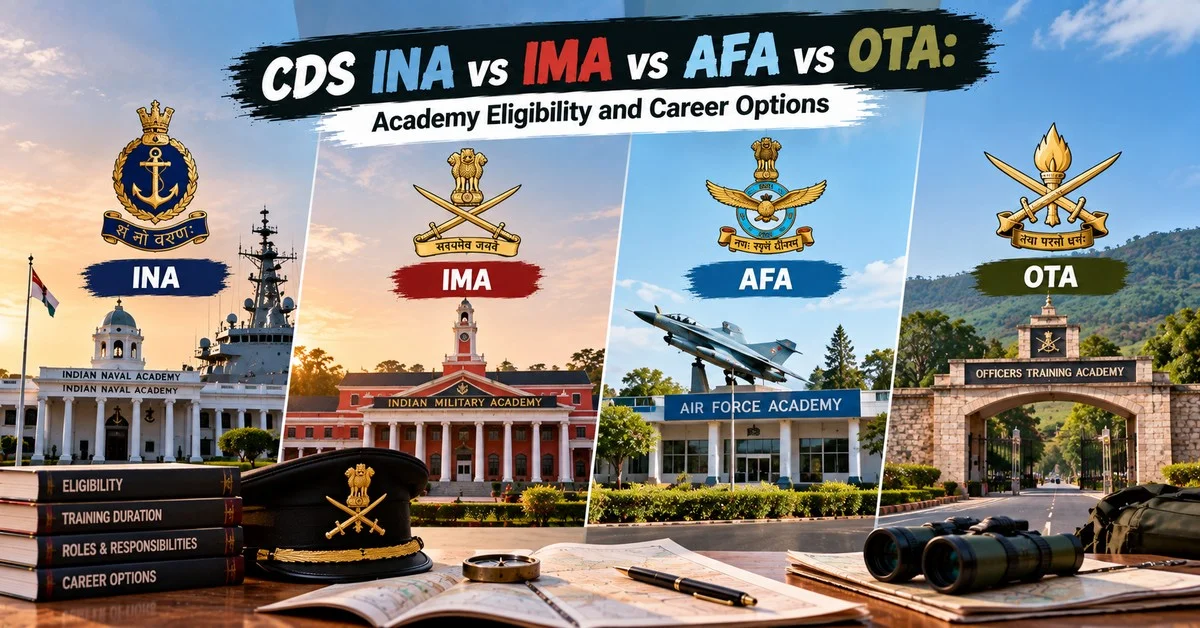
The CDS exam offers four academy options: IMA, INA, AFA and OTA. Each academy has different eligibility criteria, training durations and career opportunities across the Indian Army, Navy and Air Force. Understand their key differences to choose the right academy based on your educational background, age and career goals.
The Combined Defence Services (CDS) exam is the main UPSC route for graduates to become officers in the Indian Army, Navy and Air Force. Clearing the exam is one part of the journey. Choosing the right academy is another.
There are four CDS Academies: the Indian Military Academy (IMA), the Indian Naval Academy (INA), the Air Force Academy (AFA) and the Officers Training Academy (OTA). Each one has its own eligibility rules, training period and career path. This guide explains all four in simple terms, so you can see which options are open to you and fill your preferences with confidence.
The four CDS Academies are IMA (Army, Permanent Commission), INA (Navy), AFA (Air Force, Flying Branch) and OTA (Army, Short Service Commission). IMA, INA and AFA are open only to unmarried men, and candidates write three papers. OTA is open to both men and women, and candidates write two papers. INA and AFA require Physics and Maths in Class 12, while IMA and OTA accept graduates from any stream. When filling preferences, AFA must be your first choice and OTA your last.
CDS Academies at a Glance
Eligibility for All CDS Academies
Age and Marital Status
For AFA, candidates holding a valid Commercial Pilot Licence (CPL) issued by the DGCA get age relaxation up to 26 years.
Educational Qualification
This is one of the most important points in the whole comparison. INA and AFA are science-based entries. A BA or B.Com graduate without Physics and Maths in Class 12 can apply for IMA and OTA, but not for INA or AFA.
Final-Year Students
Candidates in the final year of their degree can apply. They must submit proof of passing by a fixed date, which is different for each academy. For CDS II 2026, the deadlines were:
-
AFA: 13 May 2027
-
IMA and INA: 1 July 2027
-
OTA: 1 October 2027
CDS Exam Papers for Each Academy
Each paper is 2 hours long, with a one-third mark deduction for each wrong answer. Candidates applying for OTA along with any other academy write all three papers.
How to Fill Academy Preferences in the CDS Form
Your preference order decides which academy you are considered for. UPSC applies a few clear rules:
-
AFA must be your first choice if you want the Air Force. If you list it second or third, it will be treated as invalid, because AFA candidates must take the pilot aptitude test (CPSS) and Air Force medicals.
-
OTA must be your last choice if you also apply for IMA, INA or AFA. If you place it higher, it will still be treated as your last preference.
-
Women candidates should choose OTA as their only preference.
-
Choose every academy you genuinely want. You are considered only for the academies you select, so it's wise to list all the options you are eligible for and happy to join.
-
Think carefully before declining. If your first choice is offered and you decline it, your candidature for the other regular commission choices is cancelled.
Example preference orders:
There's also a helpful safety net. IMA, INA and AFA candidates who qualify in the final merit list but miss out because of limited vacancies may be offered OTA, if seats remain and they are willing.
Training at CDS Academies
All cadets receive a fixed stipend of ₹56,100 per month during training.
IMA focuses on tactics, weapons, leadership, physical training and military studies, preparing officers for a full Army career.
INA begins with a 44-week Naval Orientation Course at Ezhimala. Cadets then move on to sea training and specialised courses. They are commissioned as Sub-Lieutenants after about 18 months of training.
AFA trains cadets for the Flying (Pilot) Branch. Before selection, candidates take the Computerised Pilot Selection System (CPSS). This pilot aptitude test is given only once, and the grade you receive stays valid for all future Air Force selection boards. Candidates who habitually wear spectacles are not eligible for the Air Force.
OTA delivers concentrated leadership and military training over about 49 weeks. Cadets also earn a PG Diploma in Defence Management and Strategic Studies from the University of Madras.
Career Options After Each CDS Academy
IMA: Army Officer with Permanent Commission
IMA graduates join the Indian Army with a Permanent Commission and serve until the retirement age for their rank, with a regular pension. They are posted to arms and services based on Army requirements and their performance in training.
OTA: Army Officer with Short Service Commission
OTA graduates serve for an initial 10 years, extendable to 14 years. They can be considered for Permanent Commission in their 10th year, subject to vacancies and suitability. Officers who wish to leave can apply for release in the 5th year. On release, they receive terminal gratuity, but usually not a regular pension.
INA: Naval Officer in the Executive Branch
INA graduates join the Executive Branch of the Indian Navy (General Service or Hydrography). Their careers include service on ships and at naval establishments along India's coastline and beyond.
AFA: Air Force Pilot
AFA graduates are commissioned as Flying Officers in the Flying Branch. If a cadet is suspended from flying training, they may be moved to the Navigation or Ground Duty (Non-Technical) branches, subject to vacancies.
Salary and Rank After CDS Academies
All four CDS Academies lead to the same starting pay:
Promotions follow a similar time scale across services. For example, in the Army, Captain comes after 2 years, Major after 6 years and Lieutenant Colonel after 13 years.
Which CDS Academy Is Right for You?
There is no single "best" option among the CDS Academies. The right choice depends on your background and goals:
-
You want a lifelong Army career and have any degree: IMA is a natural first choice.
-
You love the sea and have a science or engineering background: INA is worth listing.
-
You dream of flying and have Physics and Maths in Class 12: AFA should be your first choice.
-
You are a woman aspirant: OTA is your route through CDS.
-
You are 25, or prefer a defined service term: OTA suits you well.
-
You are from an arts or commerce background: IMA and OTA are both open to you.
Many candidates keep more than one door open by listing all the academies they qualify for, in the right order.
FAQs
How many academies can I join through CDS?
There are four CDS Academies: IMA, INA, AFA and OTA. Candidates can choose one or more of these, based on their eligibility.
Which CDS academies are open to women?
Through CDS, women candidates are considered only for OTA.
Can a BA or B.Com graduate apply for INA or AFA through CDS?
No. INA and AFA require Physics and Maths in Class 12, along with a science or engineering degree for INA. Arts and commerce graduates can apply for IMA and OTA.
Why must AFA be the first choice in the CDS form?
AFA candidates must take the Computerised Pilot Selection System (CPSS) and Air Force medicals. AFA listed as a second or later choice is treated as invalid.
What is the age limit for CDS academies?
As per CDS II 2026, it is 19–24 years for IMA and INA, 20–24 years for AFA, and 19–25 years for OTA.
What rank do you get after training at CDS academies?
IMA and OTA graduates become Lieutenants, INA graduates become Sub-Lieutenants, and AFA graduates become Flying Officers.
Do officers from all CDS academies get the same salary?
Yes. All start at Pay Level 10 (₹56,100 – ₹1,77,500), plus Military Service Pay of ₹15,500 per month.